
 En
En
 Español
 русский
 عربى
عربى
Custom Ice Skates: Fit Options, OEM/ODM Specs, and Buyer Sourcing Guide
Date:Oct 09, 2026
Content
- 1 Two Meanings of Custom Ice Skates, and Which One You Are Buying
- 2 Fit Customization: Adjustable Sizing, Baking, and Insoles
- 3 Build Customization: The Six Lines That Decide the Order
- 4 Supplier Capability: Why In-House Tooling Changes the Conversation
- 5 MOQ, Sampling, and What Actually Drives Cost
- 6 Procurement Risks Worth Closing Early
- 7 FAQ
A pair of children's skates comes back to a European retailer because the box says 33-36 and the boot fits neither end of that range. In the same week, a product manager asks a factory for one SKU that covers four sizes for the coming winter. Both of them want custom ice skates. They mean two different things.
Short answer first: for resale, "custom" is a build specification, not a foot scan. It appears in three places. The fit system decides how many sizes sit on a shelf. The build spec decides what the skate is made of. The commercial terms decide whether tooling, sampling, and testing pay off at your order size. For an individual skater, custom almost always means fit alone, sold one pair at a time.
The rest of this article separates those two readings, using the ice skate range of a Chinese manufacturer as a working example, and names the items to settle before tooling starts.
Two Meanings of Custom Ice Skates, and Which One You Are Buying
Custom fit is what a skater buys: a boot built to their measurements with a chosen width, stiffness, and liner, then heat-molded to the foot. It is quoted per pair and delivered to one person.
Custom build is what an importer, brand, or retail chain buys: a skate that exists only for that order. It can mean a different shell plastic, a lighter chassis, a softer liner, a private-label logo on the tongue, a wider size grid inside one shell, or packaging that drops straight onto a shelf. It is quoted per order.
Both are legitimate. The expensive mistake is asking for one and budgeting for the other.
| Decision point | Custom fit (end user) | Custom build (OEM/ODM order) |
|---|---|---|
| What changes | Foot volume, width, stiffness, liner, blade profile | Shell, chassis, blade grade, liner, closure, colour, packaging |
| Who approves it | The skater | Your product and QA teams |
| Order unit | One pair | Carton, size run, or full container |
| Lead-time driver | Fitting session and workshop queue | Sample approval, tooling, and production slot |
| Main risk | Fit expectation not met | Spec drift between approved sample and mass production |
| Cost structure | Labour-heavy, quoted per pair | Tooling plus materials plus labour, quoted per order |
Fit Customization: Adjustable Sizing, Baking, and Insoles
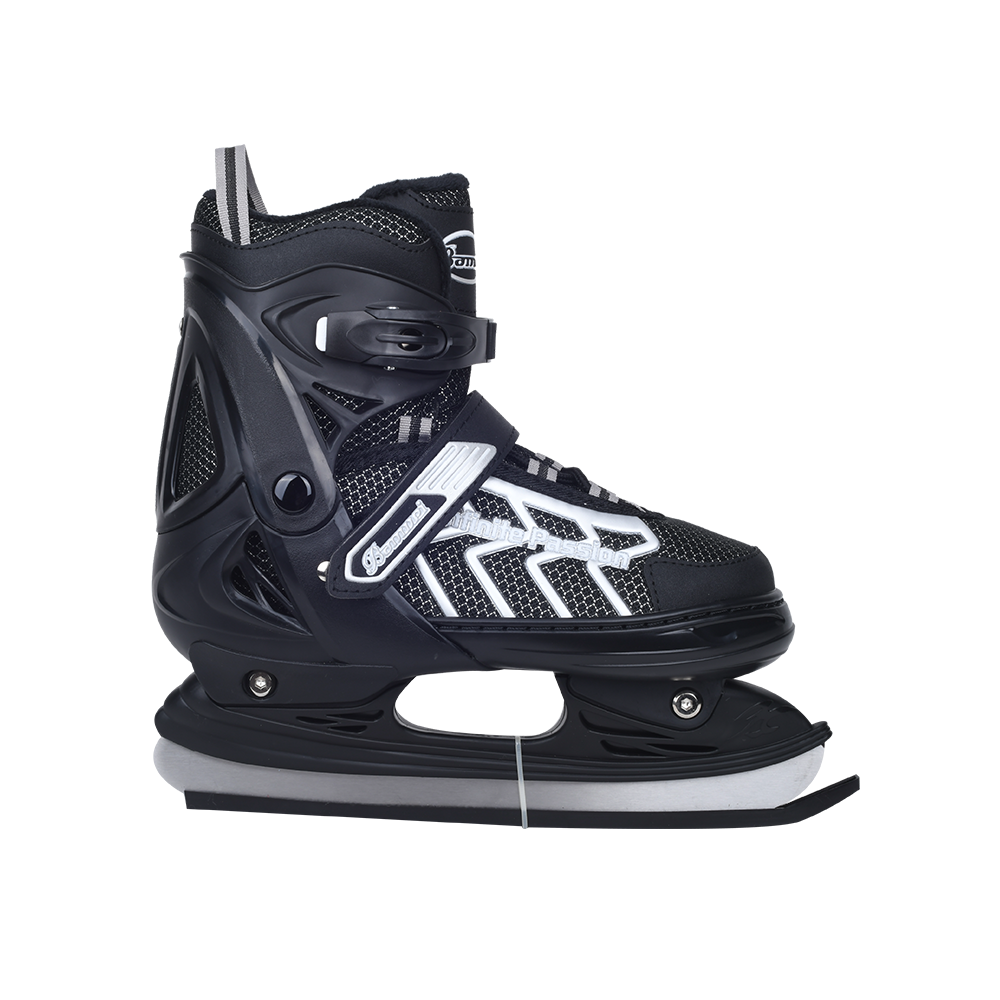
Adjustable sizing is the most cost-effective custom feature in this category, and it is why most volume-selling children's skates are adjustable. In the ice skate catalog used as the example here, eight of the thirteen listed models carry "adjustable" in the model name, from a kids' model to a professional adjustable skate. One shell can span two to four sizes, which turns a nine-row size grid into four or five rows.
That saving has a price. Every extra size inside one shell adds a mechanism: a button, a rail, or a clamp. Every mechanism is a QC point. Test the adjuster at the smallest and largest setting, never in the middle only, and ask for a holding figure or a repeat-cycle wear test in the inspection report.
Ice skate SKUs by sizing type, as listed in the manufacturer's current catalog.
Two other fit tools matter. Heat molding, often called baking, only works on thermoformable uppers. Blades must come off first, and the factory should give a temperature and time window in writing, because too much heat softens adhesives and stresses rivets. Insoles handle what sizing cannot: a thicker insole takes up volume in a loose boot, a thinner one gives it back.
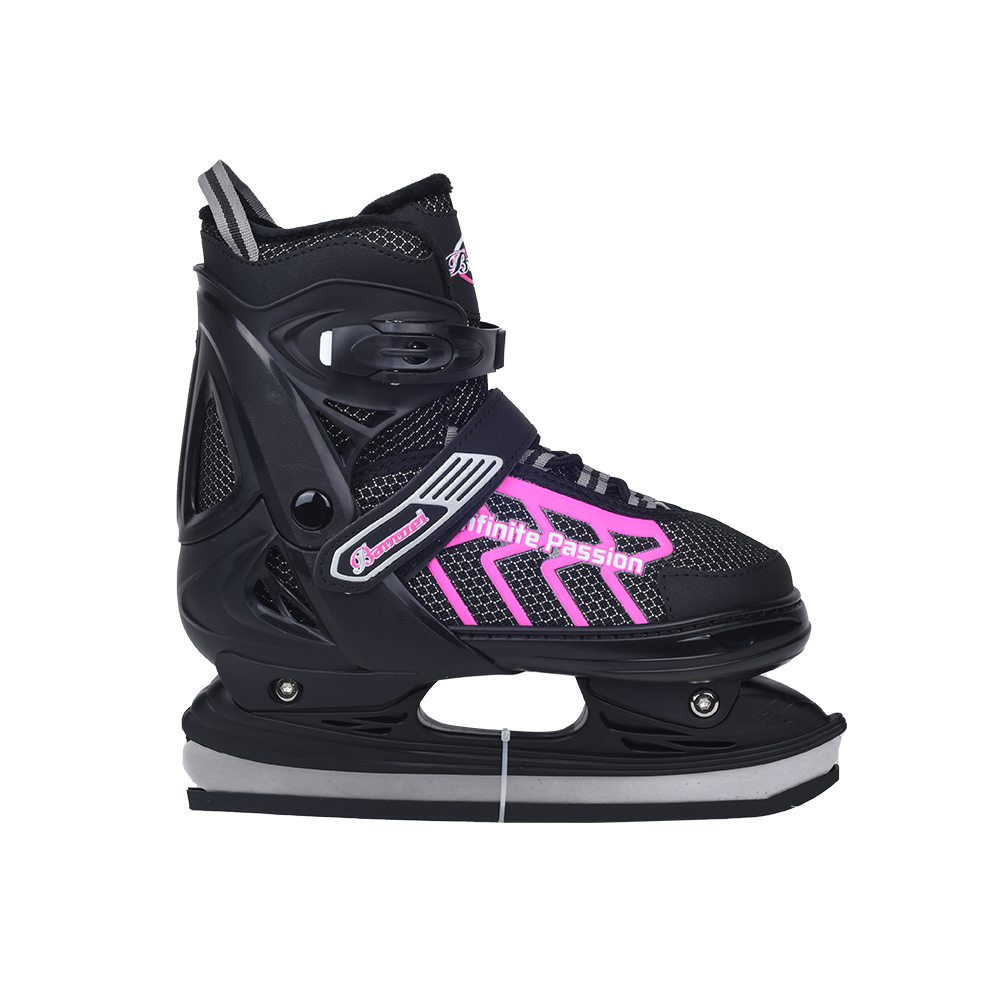 BW-128 Adjustable Ice Skates for All AgesAdjustable sizing, impact-resistant PP shell, semi-soft upper, and stainless steel blade make this minimalist skate relevant for training programs and shared family use.View Product →
Build Customization: The Six Lines That Decide the Order
Once the fit system is fixed, the spec sheet drives both cost and returns. Six lines do most of the work, and each one should be confirmed on paper rather than in conversation.
| Spec line | Options | What it decides |
|---|---|---|
| Shell and upper | Hard plastic shell, soft shell, semi-soft combination | Support, weight, and whether a young skater can put them on alone |
| Chassis | Carbon steel, aluminium alloy, plastic | Stiffness, edge protection, weight, and entry price |
| Blade | Stainless grade, edge radius, hardness declaration | Sharpening life and how consistently a shop can service it |
| Liner and padding | Foam type and thickness, brushed or mesh fabric | Comfort, blister risk, and how the skate feels after 30 minutes |
| Closure | Buckle plus lace, Velcro strap, single buckle | Independent fastening for children and the available fit range |
| Presentation | Size range, colourways, tongue branding, packaging | Size grid width, shelf appeal, and channel compliance |
Put three numbers in the purchase order instead of trusting a drawing: blade centering on the holder, edge parallelism after sharpening, and how the adjuster fits at both ends of its range. A go/no-go sample pair is worth more than a tolerance table, because it is the only version of the spec that a line worker can check in three seconds.
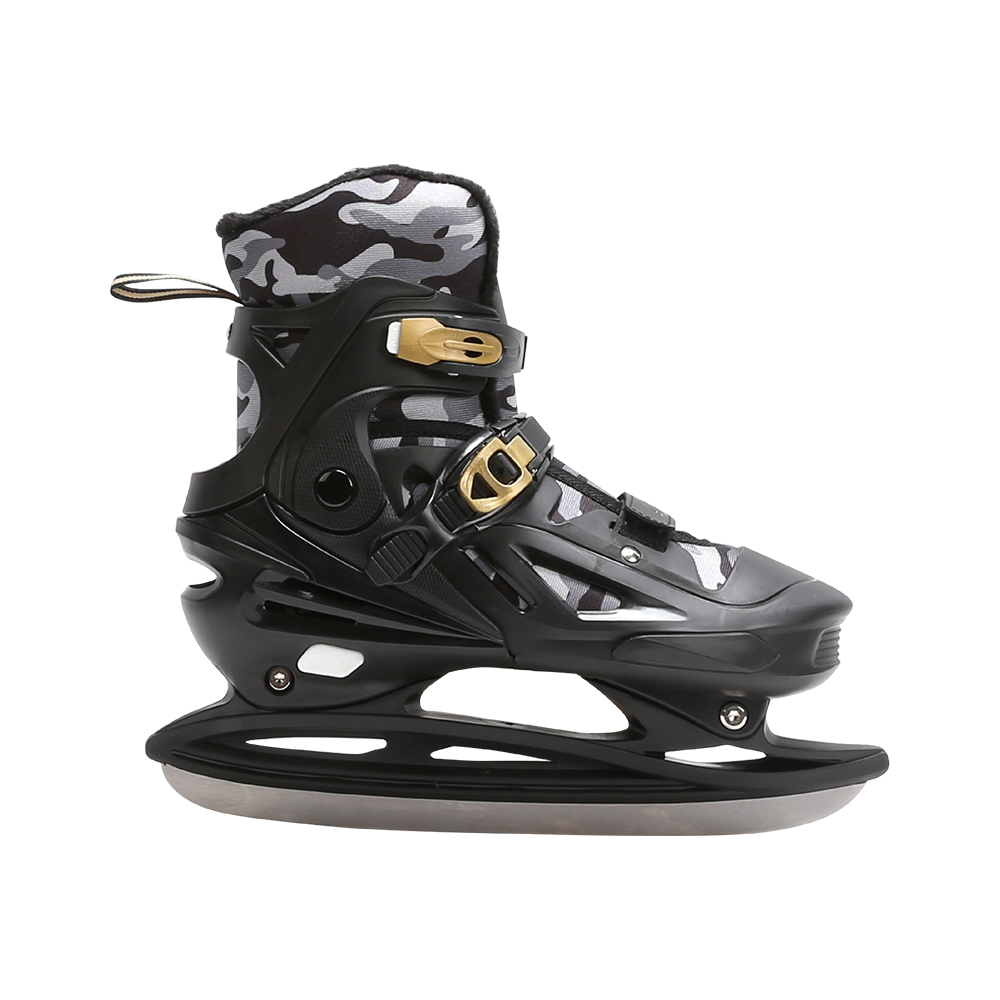 BW-230BD Carbon Steel Chassis Entry-Level Ice SkateReinforced carbon steel chassis, adjustable Velcro-and-zipper sizing, and EVA memory foam lining suit beginners, children, and adults practicing basic skating.View Product →
Supplier Capability: Why In-House Tooling Changes the Conversation
Custom work gets simpler when the supplier owns the tooling. The manufacturer behind this catalog, Ningbo Feile Sporting Goods, has operated its own mold, injection, sewing, and assembly shops since 2010 in Yuyao, Zhejiang, a district known for plastics, with a workshop of roughly 20,000 square meters, more than 200 staff, and five automated assembly lines. The sewing shop is not a detail: liners, padded uppers, and protective gear are sewn, not molded, so a supplier without one usually outsources the part of the skate that touches the skater most.
Factory-level documents claimed include ISO 9001, BSCI social compliance, and a major US retail chain's factory audit program, alongside product documents such as CE, EN71, EN62115, ASTM, EMC, 3C, and EN13843:2009. Watch the scope. A certificate covers the model it was issued for, so when the shell plastic or chassis grade changes, ask which document still applies.
- Inline skates 39
- Children's scooters 15
- Ice skates 13
- Roller skates 10
- Helmets 6
- Protective gear 6
Listed SKU counts by category, based on the manufacturer's current catalog paths.
That breadth is the practical point for a winter program: ice skates sit beside inline skates, roller skates, scooters, helmets, and pads, so one purchase order can include the safety items that would otherwise come from a second vendor.
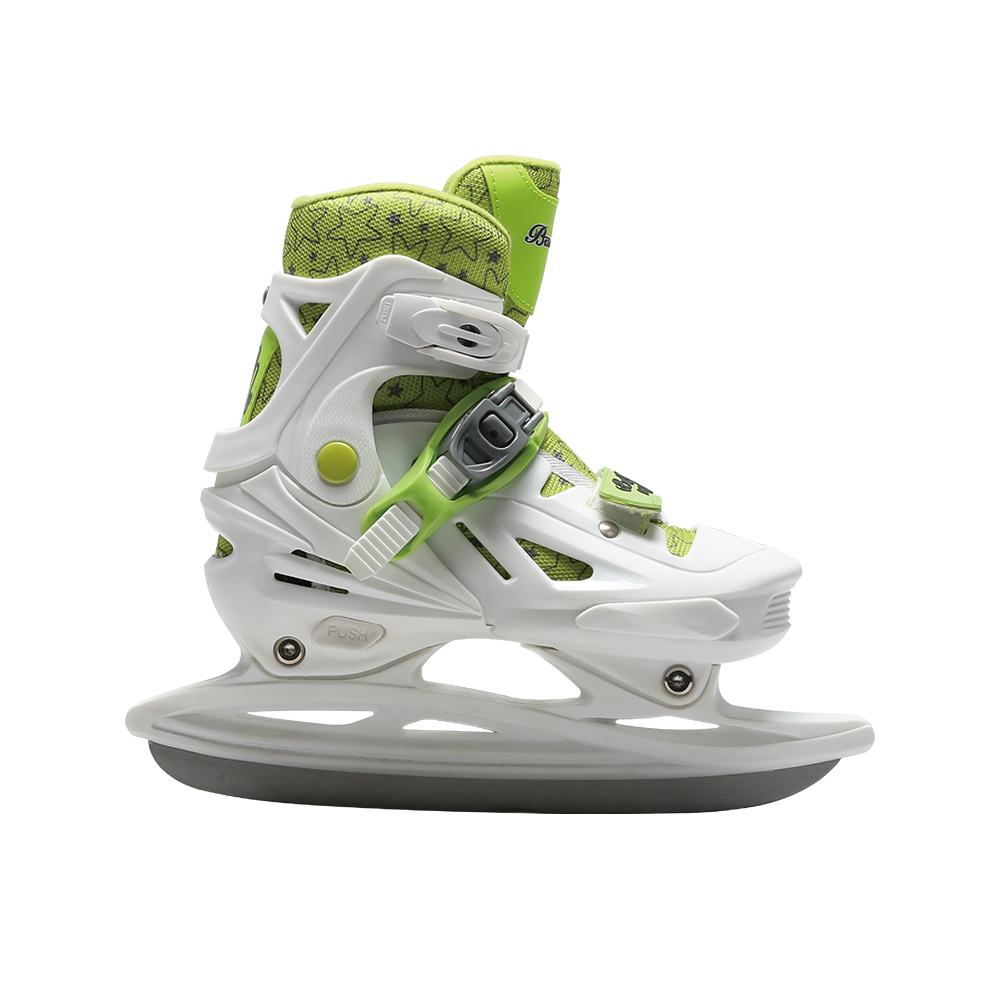 BW-220BD Lightweight Adjustable Ice Skates for ChildrenLightweight children’s skates with PVC shell, breathable mesh lining, carbon steel blades, and one-hand buckle adjustment for beginner rental or class programs.View Product →
MOQ, Sampling, and What Actually Drives Cost
Sequence the project before discussing price, because the order of steps decides the quotation.
- Spec meeting: fit system, chassis, blade, liner, closure, size grid, packaging.
- Pre-production sample in final materials, not in a nicer liner than production will use.
- Fitting and abuse test, including the adjuster at both extremes.
- Tooling, if a new shell or chassis is required, with sample approval before it is cut.
- Pilot run to confirm colour, stitching, and blade alignment across a full size run.
- Mass production with an inline check at the assembly station.
- Retail-ready packing, label check, and shipment.
Cost drivers are easy to rank. A new mold is a one-time project cost. Material swaps move unit price, especially steel against plastic chassis. Mechanism part count drives assembly labour. Colour changes and packaging printing are cheap per pair but expensive if ordered late. A logo on the tongue costs little; a new shell costs a project.
If your first order is smaller than a tooling project justifies, start with a stock model plus custom branding and packaging. This factory runs a ready-to-ship stock program for exactly that case, where trial quantities rather than container loads are the point.
Procurement Risks Worth Closing Early
- Samples approved with a better liner or thicker foam than mass production uses.
- Blade holders riveted instead of screwed, so a blade cannot be replaced at retail.
- Adjusters tested only at the middle position, hiding a failure at the largest size.
- Colour drift between batches: set a target colour reference and a stated tolerance.
- Carton, label, and language requirements checked after the goods are packed.
- Certificate scope left unverified after a material or chassis change.
FAQ
Do I need new tooling to sell custom ice skates?
No. Colour, branding, packaging, liner, blade specification, and size mix can usually change without a new shell mold. Tooling becomes necessary when you change the shell shape itself.
How many sizes should one adjustable shell cover?
Two to four for children's models is a practical range. Beyond that, the mechanism has to travel further and the boot fits the average of the range rather than the ends of it.
Is baking the same as custom fitting?
No. Baking softens a thermoformable upper so it settles around the foot; it cannot change length, width class, or stiffness. Treat it as a comfort step, not a sizing step.
What belongs in the testing file?
Model-level safety documents, factory audit records, and the inspection report for the specific production run. Keep the model number on each document so a buyer can trace which skate it covers.
Can adult skates be adjustable too?
Yes. Adjustable designs are not limited to children's sizes; a professional adjustable model in this range shows the mechanism can be built for adult skating.
Custom ice skates are a specification problem before they become a pricing problem. Decide the fit system, write the build spec, then agree the commercial terms, and most of the surprises disappear before the first mold is cut.
If you want the ice skate range, tolerances, or certificate scope checked against your market requirements, send your requirement list through the contact page and ask for the matching model numbers and sample plan.
Recommended Articles

Get in Touch
Your email address will not be published. Required fields are marked *
Have a project in mind? Contact with us!
We are happy to answer your questions. Please fill out this form
and one of our professional team will get back to you as soon as possible.

We specialize in producing various types of children's toy cars, children's skateboards, and ice skates.
