
 En
 Español
 русский
 عربى

OEM Safety Gear & Protective Equipment: A Complete Buyer's Manufacturing Guide
Date:Oct 23, 2026
Content
- 1 How an OEM Programme Is Actually Structured
- 2 The Standards Stack Behind Every SKU
- 3 Helmet Engineering: Where Cheap and Cheap-Looking Diverge
- 4 Protective Pads: Materials That Survive a Season
- 5 Building a Complete Set: Matching Gear to the Skate or Scooter
- 6 Process Control, Audits and Traceability
- 7 Planning an Order: Samples, MOQ and Lead Time
- 8 Frequently Asked Questions
Your brand approves a helmet sketch, signs the artwork proof, and issues a purchase order for 8,000 helmet-and-pad sets. Three weeks later the factory writes back: the EPS density in the spec cannot pass the drop test at the shell thickness on the drawing. Nothing in the brief changed. The physics did.
That gap is what separates OEM safety gear from ordinary OEM soft goods. Helmets, knee pads, elbow pads and wrist guards all sit under a stack of standards, and the standard, not the sketch, decides the bill of materials. Get the compliance route wrong and no tooling budget will rescue the project.
Ningbo Feile Sporting Goods has manufactured helmets, protective gear, kids' scooters, inline skates, roller skates and ice skates since 2010, with mold making, injection molding, sewing and assembly under one roof in Yuyao, Zhejiang. These are the decisions that actually move a protective-equipment programme forward.
Lock three things before design freeze:
- The destination market and the exact standard the product must be tested against
- The wearer age band and the size range the retention system has to cover
- The packaging format, plus the drop and stacking conditions it must survive
How an OEM Programme Is Actually Structured
Buyers use the word OEM loosely, and that looseness is where quotes stop being comparable. Three contract shapes cover almost every protective-gear order, and they carry different tooling costs, different timelines and different technical responsibilities.
OEM, ODM and private label
- OEM: your drawing, your tooling, your technical file. Maximum flexibility, longest schedule, tooling investment applies.
- ODM: an existing model from our range, such as a BW-series helmet or a BW02 to BW07 pad set, wearing your logo and colourway. Fastest route, lowest upfront cost, fixed geometry.
- Private label: ODM hardware with your packaging, hang tags, barcodes and manuals. This is the middle ground most mid-size brands end up choosing.
What a factory needs before a quote means anything
- A drawing or a physical reference sample
- Target market and the certificate list your retailer demands
- Size range and number of colourways
- Packaging format and master carton configuration
- Target volume per colour, per size
- Target cost band, FOB or landed
A quote without items one, two and six is a guess, and guesses tend to come back as change orders once testing starts.
The Standards Stack Behind Every SKU
Compliance is not a sticker applied at the end of production. It determines foam grade, shell material, strap width, battery enclosure design and even the ink used on the label. The table below maps the certificates we hold and test against to the decisions each one constrains.
| Standard | Typical products | What it constrains |
|---|---|---|
| EN 71-1/2/3 | Kids' scooters, skates, pads | Small parts, sharp edges, flammability, heavy metal migration |
| EN 62115 | LED wheels, spray units, sound modules | Battery compartments, wiring, overheating, insulation |
| EN 13843:2009 | Inline skates | Axle and chassis strength, wheel abrasion, brake performance |
| EN 1078 / ASTM F1492 | Helmets for skate and roller use | Impact attenuation, retention strength, coverage area |
| ASTM F963 plus CPC | US children's products | Third-party lab testing, tracking label, lead and phthalate limits |
| EMC | Electronics in LED models | Emissions and immunity of powered components |
| ISO 9001 / BSCI | Factory level | Process control, worker welfare, traceability |
Two consequences follow. First, a helmet and a pad set sold in one retail box are tested as separate items with separate reports, so swapping a foam supplier can invalidate a report if production no longer matches the tested sample. Second, colour is not neutral: a new pigment batch may need migration testing again under EN 71-3.
Helmet Engineering: Where Cheap and Cheap-Looking Diverge
Shell and liner
Most kids' and multi-sport helmets use a PC or ABS shell over EPS. The variables that matter are EPS density, commonly between 60 and 90 g/L depending on the impact target, shell thickness, and how well the liner bonds to the shell. In-mold construction gives a better bond and a slimmer profile but demands higher tooling investment and a tighter process window. Glued liners are cheaper and can still pass, provided adhesive coverage and cure time are controlled. That is precisely where budget helmets fail: on the second production run, not the first golden sample.
Ventilation versus coverage
Ventilation sells at retail; coverage passes the lab, and the two pull in opposite directions. Our ventilated skate-helmet models keep vent channels away from the impact zones and enlarge rear coverage instead. If the brief asks for a lighter helmet, expect to negotiate vent count, not coverage.
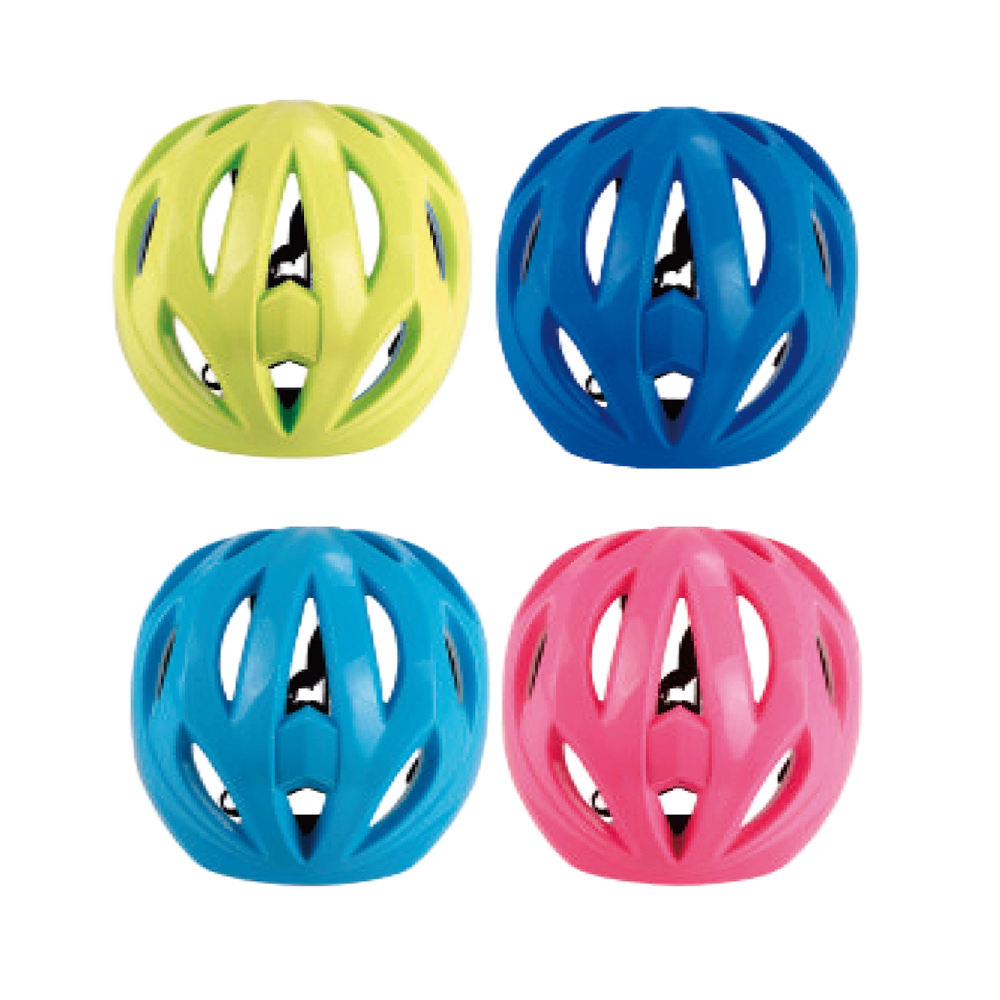 BW-014 Ventilated Skate Helmet with Rear CoveragePremium XS helmet with multiple vents, PVC/high-density EPS liner and color options, suited for hot-weather urban commuting and cycling where airflow and rear coverage matter.View Product →
Retention is the part that gets returned
Chin straps, buckles and dial adjusters generate more warranty claims than cracked shells. Specify webbing width, buckle strength and an adjuster with a defined range. If the size chart claims one size fits 48 to 56 cm, the dial has to deliver that range after 500 open and close cycles, not only on the approved sample.
Protective Pads: Materials That Survive a Season
Pad failures are rarely dramatic. They arrive as flattened foam, stretched elastic and popped stitching after about six weeks of use, usually just outside the retailer's no-questions window.
Foam choice drives the price point
- EVA: lowest cost, firm, suitable for entry price points, but prone to compression set.
- High-elasticity foam: better recovery under repeat impact, higher unit cost.
- Combination builds: a firm cap layer over a softer comfort layer, the usual answer for multi-sport sets.
Caps, stitching and straps
PP or PE caps take the abrasion so the foam does not have to. The weak point is attachment: cap edges are stitched with a bartack at every strap junction. Ask for stitch density and a bartack specification, then test by pulling straps to failure. A sample that holds 300 N tells you very little about unit 3,000. For a fuller walkthrough of foam grades, sizing and cap construction, read our complete guide to choosing sports protective gear, which we use with buyers during specification reviews.
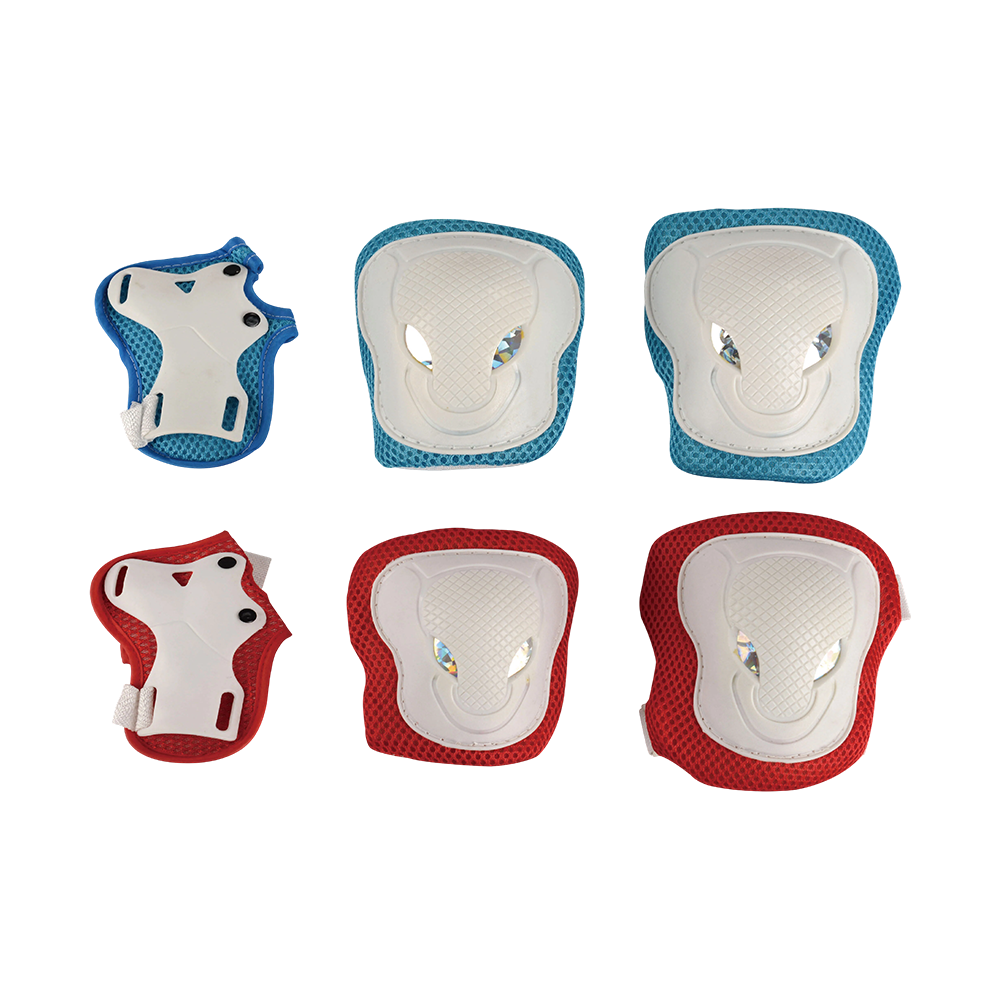 BW-04 Multisport Protective Gear Set for Skate and BMXXS modular kit with wrist, knee, elbow pads in PE, PP, EVA and 1900PA fabric, combining breathable coverage for skateboarding, BMX and street cycling.View Product →
Building a Complete Set: Matching Gear to the Skate or Scooter
Most OEM programmes we quote are not single items. They are sets: a helmet, a pad set and either an inline skate or a scooter in one retail box, one colour direction and one instruction booklet.
- Colour matching across materials: PC shells, PP caps, PU wheels and fabric absorb pigment differently, so approve colour under the same light source used for the final package.
- Size pairing: helmet sizes and skate sizes rarely line up one to one, so decide whether the carton is fixed-size or mixed and let the carton plan follow.
- Paperwork: barcodes, tracking labels, warranty cards and language variants must be locked before the print run, not after.
Some programmes bundle protection at the skate level instead, shipping a beginner inline skate with knee and elbow pads in the same carton.
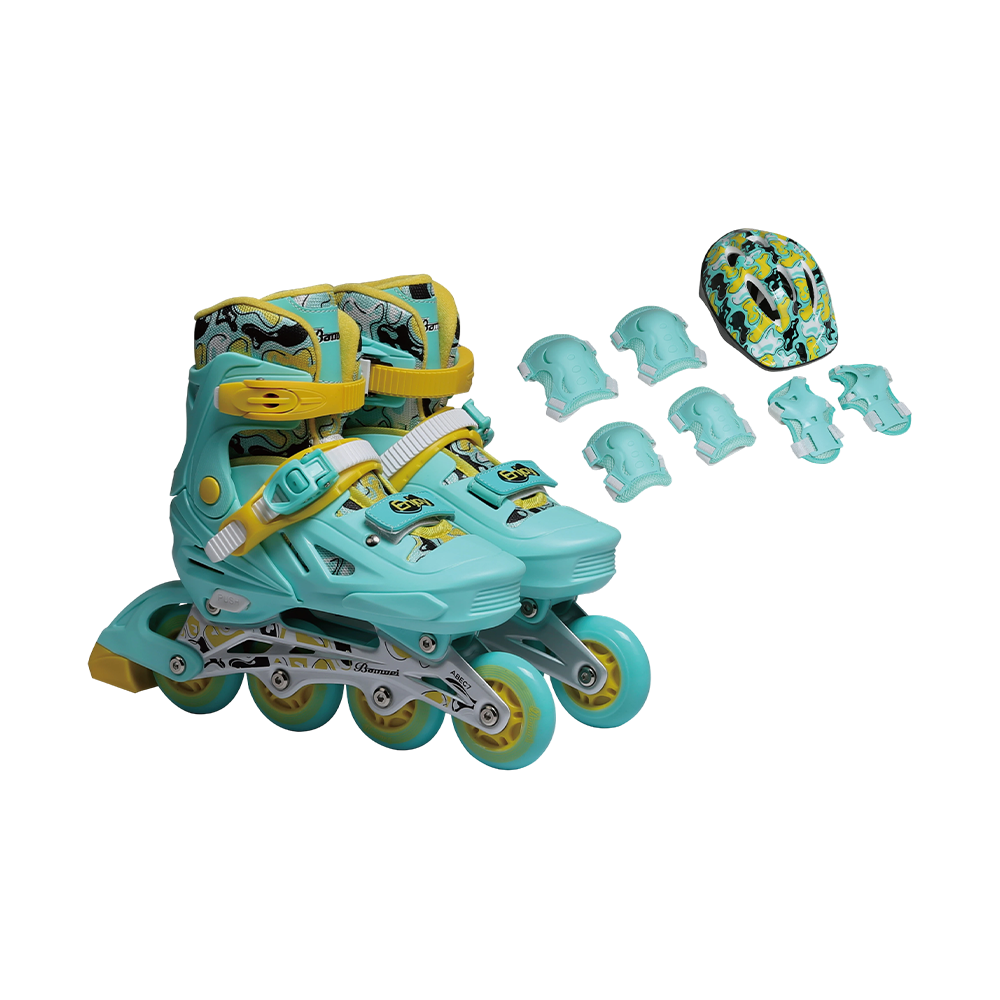 BW-220 Kids Inline Skate Set with Protective GearBeginner inline skate set for children 6-12 with helmet, knee/elbow pads and wrist guards in sizes S-L for flat-surface practice.View Product →
Process Control, Audits and Traceability
Certificates are issued to a product, but they are only repeatable when the factory behind that product is controlled. That is why serious buyers ask for factory audits and product reports together.
- In-house mold making, injection molding, sewing and assembly in Yuyao, which shortens the tolerance chain between tooling and finished goods.
- 20,000 square metres of workshop space, more than 200 staff and five automated production lines.
- Factory certifications: ISO 9001, BSCI and the Kmart factory audit system.
- Product certificates across the range: 3C, CE, EN 71, EN 62115, ASTM, EMC and EN 13843:2009.
- Incoming material inspection, in-process checks at injection and sewing stations, and AQL-based final inspection with batch traceability.
Ask for the audit report date and the testing laboratory named on each product report. An expired report, or a report listing a different foam supplier than the one in production, is a customs delay waiting to happen.
Planning an Order: Samples, MOQ and Lead Time
Schedules usually slip on the two steps nobody writes into the contract: first-article approval and golden sample sign-off. Ask for four dates in writing, covering design feedback, tooling or first article, golden sample, and production start, then treat the golden sample as the reference for every inspection afterwards.
Minimum order quantity is quoted per model, per colour and per packaging format, because tooling and material minimums drive it. A new shell mold and a new fabric dye lot carry very different minimums, so splitting a programme into existing models with new colours on one side and new tooling on the other usually lowers the entry volume.
When a launch window is short, start from items already held in our ready-to-ship stock, which covers kids' scooters and inline skates, and move the OEM tooling into the follow-up order.
Frequently Asked Questions
Is OEM safety gear different from ODM?
Yes, and the difference is contractual as much as technical. OEM means we build to your drawing and maintain your technical file. ODM means you buy an existing model and apply your brand to it. Both can carry your logo, but only OEM changes the geometry.
Which certificates does a helmet need for the EU and the US?
For skate and roller use, EN 1078 is the usual European reference and ASTM F1492 is common in the US, on top of general toy requirements such as EN 71 or ASTM F963 with a CPC. Confirm the exact list with your retailer before tooling begins.
Can you match pad colours to an existing skate line?
Yes. Send physical colour references, because a Pantone number alone does not describe PU, foam and fabric accurately, and we will produce a colour dip or sample set for approval.
What is the minimum order quantity?
It depends on tooling, colour and packaging. Request pricing at two or three volume levels so you can see where tooling amortisation drops out of the unit cost.
OEM safety gear rewards buyers who settle the standard, the materials and the packaging before the design is frozen. The order that starts with a compliance route and a compression-set specification finishes on schedule; the one that starts with a sketch finishes with a change order.
If you are planning a helmet, pad or complete-set programme for the coming season, send the drawing, the destination market and the volume band. Our engineering team will return a bill of materials, a certificate list and a timeline you can build a launch around.
Recommended Articles

Get in Touch
Your email address will not be published. Required fields are marked *
Have a project in mind? Contact with us!
We are happy to answer your questions. Please fill out this form
and one of our professional team will get back to you as soon as possible.

We specialize in producing various types of children's toy cars, children's skateboards, and ice skates.
